
0 Products - EUR 0,00
Go to cart

Andromeda, welcoming the scientific knowledge gained in recent years, tells in poetry the history of the universe, the birth of the stars, the expansion of space and the mystery that surrounds us. In this timeless immensity, the earth is irrelevant dust that, however, has the privilege of hosting life and allowing man to look, analyze, understand the laws that regulate the celestial motions and ask questions about the eternal and the infinite.
This contrast between the smallness of man and the dreams he cultivates is the leitmotif of the poem. In this challenge there is his unhappiness and his greatness. Understanding the laws that move the heavens is to share the knowledge of God and, in this sense, to approach, as in a sort of lay transubstantiation, human nature to that of God. This is why the search for God is not separated from the search for truth. Science and religion, atheism and religion and religions are part of a single research: different paths, even if imperfect and limited, to investigate the mystery.


«Eterna è l’energia, / siamo parte della sua forza / e per essa siamo divini»: Renato Fiorito has been, is, attracted by the energy of the cosmos and makes it a poem. From the informative to today the poet crosses skies and universes and the reasons about them are gutted by humans, fascinated mostly, often amazed, always with a sort of devotion to the immense surroundings. Not without reason he stops, even closes his verses, on the woman, on the "remains", on Lucy, the little woman in whose head, metaphorically, «vivevano le storie dei millenni, / scorreva nel sangue il desiderio di milioni di uomini, / gli amori di tutti i tempi...».

  Andromeda releases on one side the sides of a path - consciously or not consciously guided by the living, natural beings of the three kingdoms - infinite, coming from unimaginable but imagined times; on the other side the question about the slow presence to define oneself of the animate beings who constituted life. Perhaps without intrinsic "why" or "how" life has been formed and therefore determined, but certainly with the observation, subterranean in the poem itself, that, having been and being life on earth, it brings with it the necessity that there be again, that it is not destroyed. Life was born from the shapeless. It has taken its forms over millions of years. In millions of years, perhaps, it will have the forms of other metamorphoses since nothing«è più eterno della sua evoluzione». Oggi ha una forma amata e da amare per motivi dicibili o anche indicibili e per il fatto che «...nulla mai muore davvero».


written by Federico Migliorati

Decana of the Italian poetesses, born in 1929, Curzia Ferrari (at the Calcagno registry office) is presented to the public in its widest range of intellectuals in the round thanks to the recent work by Vincenzo Guarracino entitled "Tutto o niente" (Giuliano Ladolfi Editore, 90 pages, 10 euros). Guarracino, an authoritative scholar of Leopardi and Verga, a famous Latinist and Greek artist, delineates a fine portrait of Ferrari, with a critical and precise analysis that leaves space, at the end, to a conversation with the heart in his hands. A life that is anything but linear and simple, both in the professional activity and in the affections, that of the Milanese poetess, which emerges imperious as a whole plumbs her way backwards in time. From family quarrels (with the father above all, that will lead her to change the father's surname with that of her husband) to the existential dilemmas of which his poetry is rich. Not only on the other hand, however, has been nourished by the soul of Ferrari, whose pen has proved "multifaceted and ductile": even in the narrative, in non-fiction, journalism has been able to show off without forgetting the translations and especially the biographies (on all that of Majakovsky) in which the Milanese writer demonstrates "empathetic and mimetic" skills, coming to rebuild and relive the character, man or woman, from the inside.


What motivated Renato Fiorito to penetrate the poetic territory of cosmogony, the origin of the universe, the appearance of life forms on Earth, the evolution of humans, what moved him to face a business that, as well underlines Giuliano Ladolfi in the introduction to the volume, entitled The epic of the universe, was he already Hesiod and Lucretius in the classical world and many others in later periods? The answer to this question permeates the whole poem Andromeda, stretched between the 'prelude' On the edge of the sky and an Epilogue that shows clearly and accomplished a relevant character of the whole work, namely the alternation of two rhythms, the narrative and the contemplative one. The answer to the question, in fact, lies in the goad-end-function of the human, and of the thinking and poetant human, that is to say in the permanent interrogation, in the wonder that generates questions.
The three initial verses of Andromeda are a statement - exemplary for synthesis, sapidity, cadence - of respect to three points that we should never ignore in reading a work: the perspective in which the lyric self is placed and from which it moves the his look; the vision that the lyric self has of itself, especially in this case, as human among humans; finally the enunciation of his poetic 'subject'. Here, then, the three verses:

Sul limitare del cielo
io, scintilla di un attimo
canto l’infinito.


Claudio Pagelli was born in Como in 1975. He graduated in Law, since 2004 he is president of the Heliant Cultural Artistic Association. He wrote poetry collections: L'incerta specie (2005); The visions of the clover (2007); I ate the crazy flower (2008); Buchi Bianchi (2010); Papez (2011) and The Vocation of the Whale (2015). Also: three artistic plaquettes (Ed. Pulcino elefante); the plaquette of haiku Bestiario with sushi (Ed. I Tipografni del Typografo). Awarded in numerous literary competitions, his poems appear in art catalogs, trade magazines and theme sites. Translated into Spanish, it was published in the Periodico de Poesia U.N.A.M.

Given for sure that insects will be the food of the future - as long as they convince us to nourish them - in this collection they have a more noble function: that of nourishing the mind and the heart of the readers, as an alter ego not only of the poet, but of men all. The idea is original (Gozzano - as recalled by the Prefactor - had not been able to complete his work "Butterflies: entomological epistles"); it is made with short compositions, cleaned of any redundancy, which seems to leave the reader attentive - the pleasure of continuing the story, following his own imagination. Intense squares, in which anthropomorphism is evoked enough, since insects and humans - both belonging to the animal kingdom - are differentiated not only by biology and classification, but also by behaviors and characteristics of their existence.


  1. Pietra e Farfalla on Poesiaeletteratura.it
  2. Riconoscimento a Dato Magradze
  3. Aforismi da pausa caffé on Avvenire
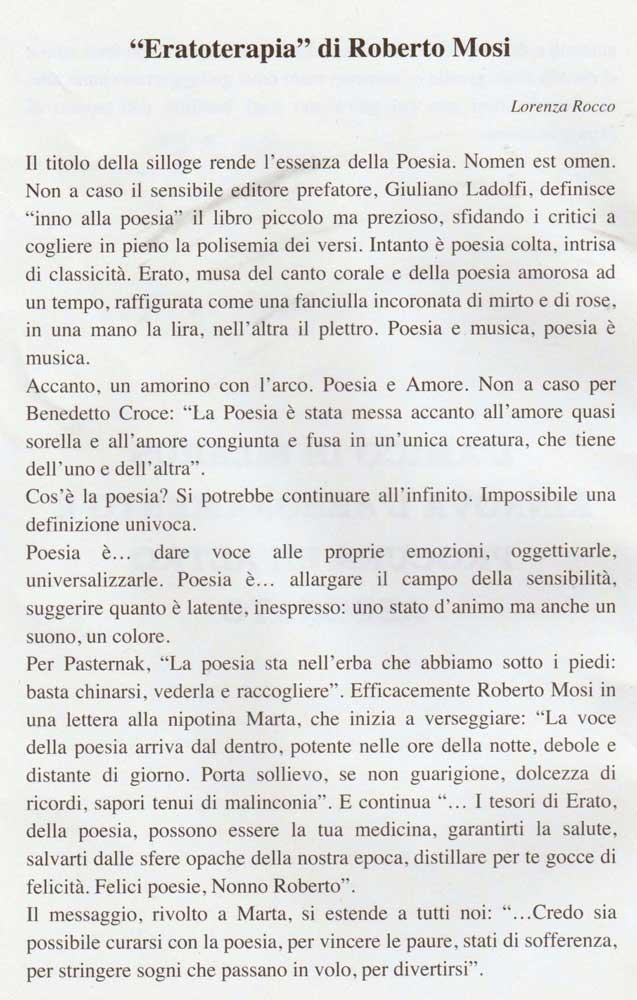
  4. Eratoterapia review by Paola Lucarini

Page 17 of 76

ACQUISTI

Per acquistare i nostri libri

inviaci una richiesta a

ladolfi.editore@gmail.com


If you want to purchase

our books

please send a request to

ladolfi.editore@gmail.com


GIULIANO LADOLFI EDITORE s.r.l.

Corso Roma 168

28021 Borgomanero (NO)

Tel. +39 0322 835681

This email address is being protected from spambots. You need JavaScript enabled to view it.

NEWSLETTER SUBSCRIPTION

I agree with the Terms and Conditions

Per offrire il miglior servizio possibile questo sito utilizza i cookies. Continuando la navigazione si autorizza l’uso. To offer the best possible service this site uses cookies. By continuing to browse, you authorize use.